

WHY INDICATE LIFE?
The built environment is responsible for approximately 40% of all global carbon emissions. In order to align with the 1.5°C Paris Agreement goals and reach climate neutrality by 2050, Europe must act now in reducing whole life carbon (WLC) emissions across Europe’s built environment. Addressing these WLC emissions includes tackling both operational and embodied carbon.
INDICATE LIFE aims to address one of the biggest challenges in reducing these emissions by improving the life cycle assessment (LCA) data quality and availability of buildings within Europe. Lack of building LCA data is widely understood to be a key obstacle in achieving industry and policy action on WLC.

WHAT IS INDICATE LIFE?
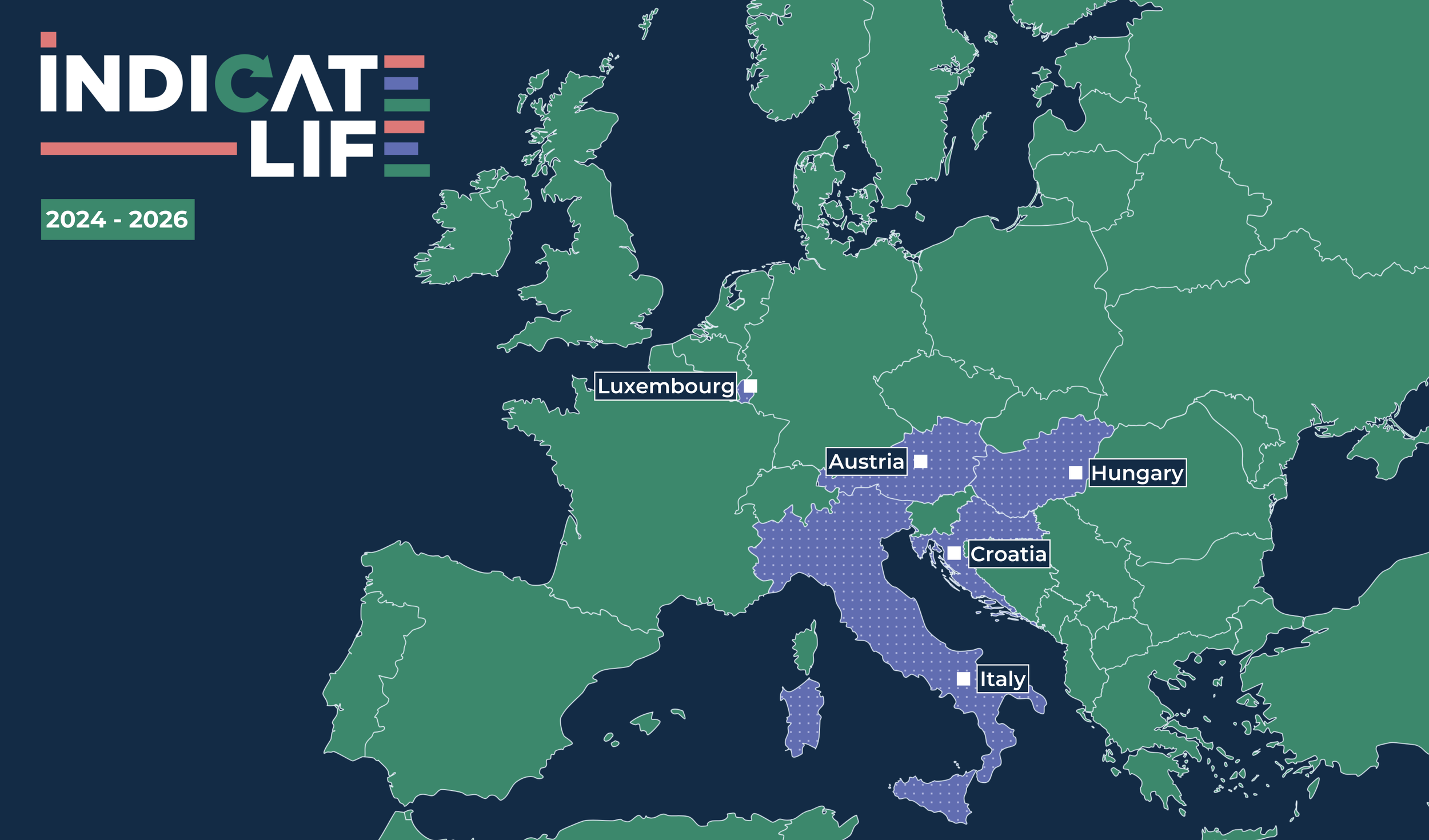
Following the success of the INDICATE Pilot Project project, which supported Spain, Ireland and the Czech Republic in collecting and generating representative LCA data to be used in national WLC regulations, INDICATE LIFE, which is taking place between 2024 to 2026, will extend this approach to another five EU Member States: Italy, Austria, Croatia, Luxembourg and Hungary (as a follower country). INDICATE LIFE will build upon the proven successful methods and utilise the learnings from the pilot countries with established WLC databases developed through INDICATE Pilot.
National partnerships between industry stakeholders, policymakers, data providers and academia will ensure guidance and technical support is given where necessary for all stages of the project's duration by relevant experts. This collaborative approach will support the five EU Member States in achieving the following objectives:
Developing national tools and assessment methods for WLC calculations which align with upcoming EU directives, such as the updated Energy Performance of Buildings Directive (EPBD)
Driving data collection and analysis to create national benchmark WLC values for new developments and retrofits
Carrying out an assessment of the cost-benefits LCA to support policy-level action
Enabling EU and national level WLC recommendations through national market and policy comparisons; requiring transparency in reporting

INDICATE LIFE is providing both financial and technical support to strengthen national LCA data and drive policy change.
Smith, KU Leuven, RISE, BPIE and WorldGBC will contribute through the development of guidance materials, technical assistance and centralised analysis. This work will inform INDICATE LIFE’s WLC assessment methods and data generation, with input from key national experts to ensure it is optimised for new construction projects.
National consortia will then implement the INDICATE LIFE methodology, influenced by the INDICATE Pilot, receiving guidance from the coordinating partners where necessary. With this support, the costs and benefits of implementing WLC regulations can be established through examples from frontrunning countries, helping to shape future national policies.
PARTICIPATING COUNTRIES
Building on the work of the three pilot countries from the INDICATE Pilot , INDICATE LIFE is supporting an additional five EU countries to improve the quality, quantity and application of building-level LCA data, with the aim of regulating and reducing the WLC footprint of buildings.
Learn more about the national implementation in the five participating countries: Austria, Croatia, Italy, Luxembourg and Hungary (as a follower country).
-
NATIONAL CONTEXT:
The Italian context is characterised by various initiatives to target WLC building assessment. At the legislative level, Green Public Procurement requires mandatory LCA for public buildings and defines reward WLC/LCA-based criteria in tenders. As a key strategy, the “Italian roadmap to achieve the 2050 climate goals” has been developed by GBC Italia, setting out actions for the building value chain’s actors and proposing a WLC methodology for new and existing buildings (not yet adopted into policies). Concerning data, the Italian LCA database “Arcadia” is in progress, making available LCA data representative of the national supply chain. Italy needs a harmonised national methodology and database to make WLC results comparable and define building reference value, increasing stakeholders’ awareness.
ADVOCACY AND INDUSTRY AMBITIONS:
The INDICATE LIFE project aims to drive WLC data and building-level LCA adoption in Italy to align industry and policy actions towards decarbonisation. At the core is the creation of national WLC benchmarks, specifically for residential and non-residential buildings, and a shared methodology in joint compliance with both EU standards (Level(s) and EPBD) and the Italian regulatory framework (Green Public Procurement). To achieve this, a representative sample of building LCA case studies across regions will be analysed. The project’s co-creation approach ensures that stakeholders not only contribute to but also act upon the data and outcomes, prompting change in practice.
ITALIAN CONSORTIUM PARTNERS
Green Building Council Italia, University of Bergamo, ENEA, Politecnico Di Milano, Harpaceas, Politecnico Di Torino
For more information on the Italian INDICATE LIFE project, please contact Valentina Marino via email: valentina.marino@gbcitalia.org
-
NATIONAL CONTEXT:
Austria is advancing its WLC efforts, focusing on European alignment, improved data availability, and overcoming barriers. WLC data relies on EN 15978 standards but faces challenges in harmonising datasets, limited generic data, and high costs. The OIB Richtlinie 7, to be implemented by 2027, sets standards for life cycle emissions, material documentation, waste management, and adaptability, incorporating databases and accurate life cycle analysis. Contributions from TU Graz, ATP sustain, einszueins architektur, and ÖGNI support WLC progress through innovative methodologies, sustainable design applications, and global collaboration, enhancing Austria's role in sustainable construction practices.
ADVOCACY AND INDUSTRY AMBITIONS:
The INDICATE LIFE project supports Austria by standardising WLC methodologies to be aligned with European standards such as Level(s) and the EPBD and developing a centralised LCA emissions database which will improve accessibility and consistency for national stakeholders. Additionally, this will provide baseline data for policy benchmarks. It fosters collaboration among stakeholders and aligns Austria’s construction sector with EU decarbonisation goals.
AUSTRIAN CONSORTIUM PARTNERS:
Austrian Sustainable Building Council ÖGNI , Einszueins Architektur, Tu Graz, ATP Sustain
For more information on the Austrian INDICATE LIFE project, please contact Martin Ramsauer via email: martin.ramsauer@ogni.at
-
NATIONAL CONTEXT:
In Luxembourg, there is a public certification specifically for housing (LENOZ) that includes LCA criteria and aims to promote sustainable building practices. The LENOZ certification is voluntary and encouraged through subsidies. In addition, there are private certifications which incorporate LCA in their frameworks. Despite these initiatives, Luxembourg does not have a national database of Environmental Product Declarations (EPD). The absence of a national EPD database poses a challenge for harmonising LCA practices across the national construction sector. Furthermore, Luxembourg’s reliance on imported materials introduces a high degree of data heterogeneity, requiring harmonisation to ensure consistency and comparability in LCA assessments.
ADVOCACY AND INDUSTRY AMBITIONS:
The national INDICATE LIFE project aims to build a harmonised database of WLC assessments of buildings in Luxembourg. This will help identify emission hotspots and effectively guide policy towards decarbonisation across the value chain. INDICATE LIFE is a crucial component of the national roadmap, accelerating the national data collection effort. The project will provide the infrastructure to collect case studies, develop a national WLC methodology, perform harmonised WLC calculations, analyse the results, and deliver valuable insights for policy action. An important stakeholder in this process is the Conseil national pour la construction durable (CNCD, the national Green Building Council), which brings together representatives from the entire value chain and guides the effort.
LUXEMBOURGISH CONSORTIUM PARTNERS:
Ministere De L’economie,Luxembourg Institute of Science and Technology, Energie et Environnement, CDEC
For more information on the Luxembourgish INDICATE LIFE project, please contact Paul Baustert via email: paul.baustert@eco.etat.lu
-
NATIONAL CONTEXT:
Croatia is in the early stages of developing comprehensive WLC data systems. Availability of LCA and WLC data is limited and scattered across institutions or reliant on international databases. There is no unified national database tailored to Croatia’s construction sector, making consistent, locally relevant data hard to access. Currently, Croatia lacks a standardised national methodology for WLC calculations. Stakeholders often rely on international tools and practices that may not fully account for the local context, such as specific materials, construction techniques, or regional environmental impacts, limiting accurate assessments and benchmarks for sustainable construction practices.
ADVOCACY AND INDUSTRY AMBITIONS:
The national INDICATE LIFE implementation is a game-changer for Croatia’s journey toward sustainable construction. By bringing together key actors, it is building a foundation for advanced LCA data. The national team has evaluated Croatia’s current tools and compared them to global best practices to identify ways to improve accuracy and impact. This aims to result in reliable benchmarks, cutting-edge solutions, and actionable insights to drive sustainability in the construction sector. LCA findings will shape building codes, inspire policies, and empower professionals. Through public engagement, awareness campaigns, and collaboration, this project aligns Croatia's construction sector with EU sustainability goals and supports its transition to a low-carbon economy.
CROATIAN CONSORTIUM PARTNERS:
Green Building Council Croatia, University of Zagreb Faculty of Civil Engineering, EIHP
For more information on the Croatian INDICATE LIFE project, please contact Franciska Erdelj via email: franciska.erdelj@gbccroatia.org
-
NATIONAL CONTEXT:
In Hungary, the Decarbonisation Roadmap for the Building Sector has been developed by Hungary GBC as part of the Building Life project, analysing the current situation and setting out future target values and actions for all building value chain actors. A net zero carbon building definition targeting WLC greenhouse gas emissions has been provided in the Advancing Net Zero project.
While the number of Environmental Product Declarations (EPD) for building products increasing rapidly, there is no national database yet. There is also a growing interest in building LCA, particularly in relation to green certification, but a common methodology is lacking. To ensure comparability in LCA assessments and establish benchmark values, Hungary needs a harmonised national methodology and database.
ADVOCACY AND INDUSTRY AMBITIONS:
Hungary has an observer role, with lighter involvement during INDICATE LIFE. The project will support the preparation phase for WLC policies. The aim is to establish a strategy for database and methodology development, and to engage relevant stakeholders through workshops. Hungary can benefit from the knowledge and experience shared within the international consortium.
HUNGARIAN CONSORTIUM PARTNER:
Hungary Green Building Council
For more information on the Hungarian INDICATE LIFE project, please contact Zsuzsa Szalay via email drzsuzsaszalay@gmail.com

THE TIME TO ACT IS NOW!
Everyone can contribute to improving the availability of data.
Suppliers and manufacturers can ensure they provide Environmental Product Declarations (EPD) for all their products.
Developers and designers can request EPDs for all products and ensure WLC assessments are performed and published for all their projects.
The public sector and political leaders can support by committing to enact WLC policy and engaging with stakeholders to find the best data and start to develop baselines.
Sign up to receive the INDICATE LIFE newsletter!
The INDICATE LIFE project is co-funded by the European Union’s LIFE Programme under Grant Agreement No 101167585.
indicatedata@smithinnovation.dk