
Deliverable 3.1: Guidance Document on National Benchmark Development and WLC Hotspots Analysis
This report, led by KU Leuven under the INDICATE LIFE project, explores how whole life carbon (WLC) benchmarks can support more consistent and comparable assessments across Europe. It examines existing approaches, data gaps and methodological challenges, and outlines key considerations for developing robust, policy-relevant WLC benchmarks. The findings can provide an important foundation for future regulation and market uptake.
Deliverable 7.24: Italy Sub-Report on Cost-Benefit Analysis
While awareness of whole life carbon (WLC) is growing in Italy, it is not yet standard practice. This sub-report, developed under the INDICATE LIFE project and led by POLITO, explores how designers, institutions and early adopters are approaching WLC today, and where key barriers remain.
Drawing on stakeholder interviews and real case studies, it highlights the growing value of WLC and what Italy needs to be ready for EPBD requirements.
Deliverable 7.15: Croatia Sub-Report on Cost-Benefit Analysis
Croatia is at an early stage of whole life carbon (WLC) implementation, with assessments still voluntary and fragmented. This sub-report, part of the INDICATE LIFE project and authored by EIHP, explores insights from early adopters, revealing how design choices can significantly influence carbon outcomes. With EU requirements approaching, it highlights the gaps, challenges and priorities shaping Croatia’s path towards mandatory WLC.
Deliverable 7.33: Luxembourg Sub-Report on Cost-Benefit Analysis
INDICATE LIFE examines the role of whole life carbon (WLC) regulation in advancing sustainable building practices in Luxembourg. This report by the Ministry of Economy (MECO) highlights how carefully designed policies can achieve emission reductions, promote innovation, and manage costs, while highlighting potential risks from inadequate implementation. Insights are illustrated through nine real-world case studies from Luxembourg.
Deliverable 7.6: Austria Sub-Report on Cost-Benefit Analysis
In Austria, whole life carbon (WLC) assessments are starting to influence how buildings are designed. This sub-report, developed under the INDICATE LIFE project and led by ÖGNI, draws on real building projects to explore the environmental and economic value of WLC assessments. The report highlights where WLC delivers clear benefits, where challenges persist, and what is needed to scale implementation ahead of EPBD requirements.
Zero Emission Buildings Paper
This paper by the University of Zagreb provides an overview of the provisions and comments on the draft Delegated Act resulting from the INDICATE LIFE project. The Directive requires zero emission buildings (ZEB) based on high energy efficiency and renewable energy, while the Delegated Act establishes a common methodology. This paper is written in Croatian.

INDICATE LIFE objectives
This infographic provides a summary of the main objectives of the INDICATE LIFE project.
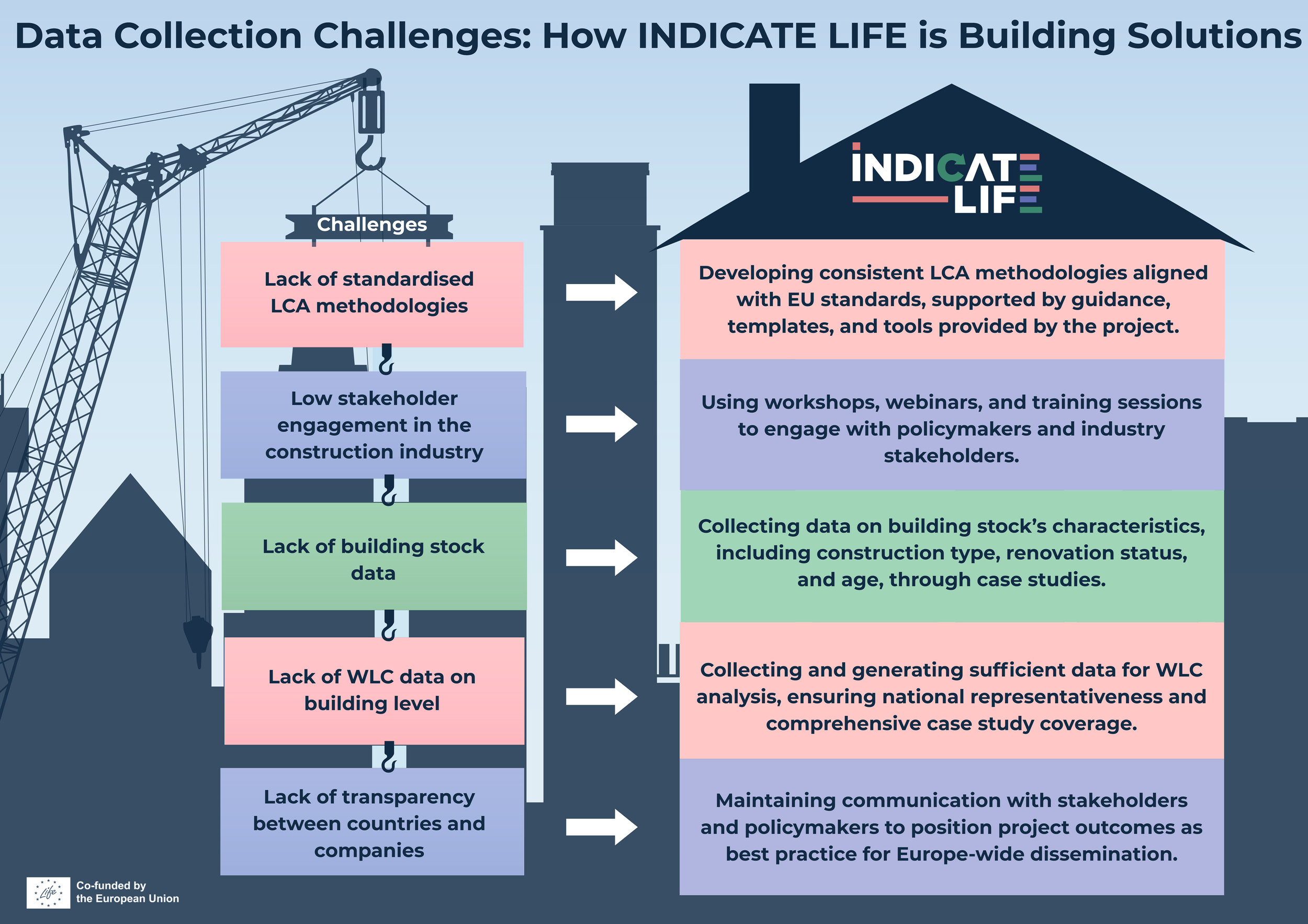
Data collection challenges and how INDICATE LIFE is building solutions
This Infographic provides details on the data collection challenges faced in the INDICATE LIFE project, and how INDICATE LIFE is providing solutions to these.
Data Infrastructure for WLC Emissions Baselines of Buildings in Spain
This Academic Paper, developed under the INDICATE Pilot Project, addresses the lack of a harmonised LCA method in Spain by developing a data infrastructure based on co-creation, the development of new data and the compilation of existing data.